Webflow vs WordPress: Complete CMS Comparison for Marketing Teams
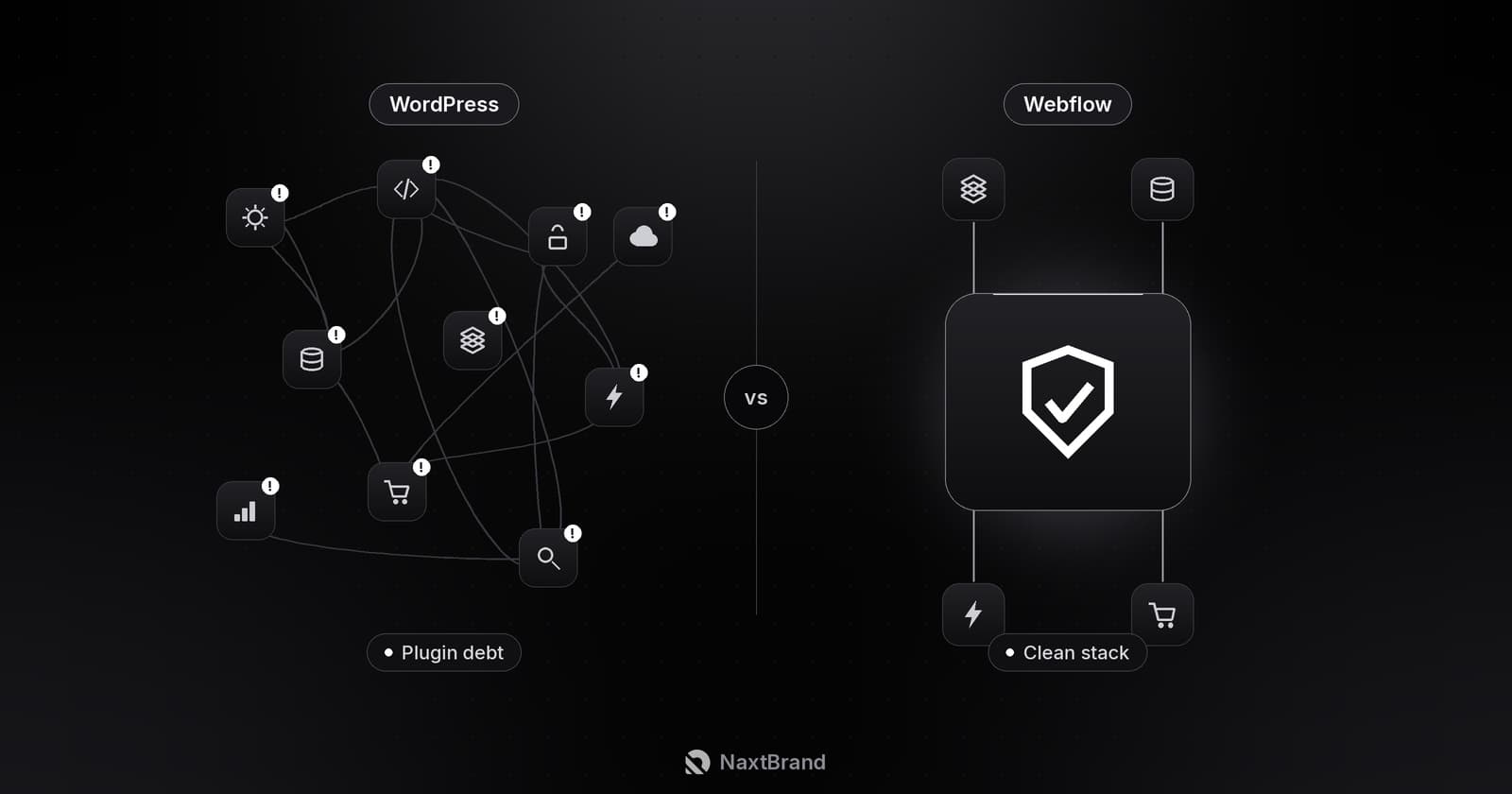
Choosing the right architectural approach is not simply a matter of visual preference. For technical leaders and commercial executives, selecting between modern technologies directly dictates engineering velocity, customer acquisition efficiency, and system reliability.
At NaxtBrand, our engineering-led specialists evaluate platforms and digital search strategies through verified code standards and concrete metrics. Whether you are launching a new commercial brand or scaling an existing architecture, exploring our dedicated custom WordPress development services provides the foundation required to capture lasting market share.
Architectural Comparison & Core Decision Matrix
Understanding how competing solutions stack up across commercial pillars is critical before committing capital and engineering resources:
1. Underlying System Architecture & Performance
The foundational code architecture of any digital asset dictates how efficiently browsers render visual elements and how search crawlers parse content. When platforms rely on heavy client-side JavaScript execution or bloated third-party plugin ecosystems, server response times (TTFB) degrade and visual layout shifts (CLS) frustrate end users.
Modern engineering principles enforce clean component boundaries, optimized static generation, and edge content caching. By delivering pre-rendered semantic HTML, high-growth organizations ensure that potential customers experience sub-second page loads regardless of device or geographical location.
Explore how our technical squad approaches enterprise performance through our custom WordPress development services.
2. Total Cost of Ownership and Scaling Economics
A frequent mistake in digital strategy is evaluating software purely on initial setup costs while overlooking recurring operational overhead. Proprietary SaaS platforms often entice teams with modest entry tiers, only to introduce compounding per-user seat fees, transaction penalties, and required third-party app subscriptions as business volume scales.
When calculating the Total Cost of Ownership (TCO), senior decision-makers evaluate:
- Monthly Licensing & Seat Escalations: How costs scale when your customer base or team headcount grows 10x.
- Maintenance & Dependency Vulnerabilities: Developer hours required each month to patch outdated extensions.
- Data Portability & Vendor Lock-In: The ease or friction involved in exporting complete customer databases and proprietary business logic.
- Conversion Friction: The revenue lost when checkout flows cannot be customized to remove friction points.
Investing in clean, decoupled infrastructure ensures your organization maintains 100% intellectual property ownership and eliminates recurring vendor penalties.
3. Search Engine Visibility and Entity Optimization
Search engines evaluate platforms through strict technical ranking signals, including Core Web Vitals, crawl efficiency, and structured data completeness. While standard visual builders offer basic title tag customization, they frequently fail to compile structured Schema.org JSON-LD graphs that modern search bots require for AI Overviews and Rich Results.
A rigorous search optimization strategy requires:
- Semantic HTML Hierarchy: Clean article, main, header, and section tags establishing logical content outlines.
- Entity Schema Graphs: Connecting Organization, Service, BreadcrumbList, and FAQPage nodes directly in page headers.
- Zero Redirect Chains: Maintaining clean 1-to-1 canonical routes across your domain hierarchy.
- Sub-Second Core Web Vitals: Ensuring Largest Contentful Paint (LCP) triggers in under 1.2 seconds on mobile networks.
For organizations looking to scale organic search revenue, aligning technical foundations with editorial authority is non-negotiable. Learn more about our proven technical SEO services.
4. Operational Best Practices & Implementation Roadmap
To execute with maximum velocity and avoid accumulating technical debt, engineering leaders and marketing directors should adhere to these core guidelines:
- Standardize Design Tokens Early: Establish type scales, color tokens, and layout constraints in Figma before initiating frontend development. This eliminates design drift and reduces component refactoring.
- Eliminate Redundant Client-Side Scripts: Audit tracking tags and third-party widgets quarterly. Every superfluous script injected via tag managers inflates DOM size and delays main-thread responsiveness.
- Automate Webhook & CRM Synchronization: Avoid brittle manual CSV exports by wiring lead forms and e-commerce transactions directly to webhook endpoints and automated workflow queues.
- Enforce Server-Side Telemetry: Rely on server-side GA4 and conversion tracking APIs rather than purely client-side pixels, which are increasingly blocked by browser privacy controls and ad blockers.
5. Technical Decision Matrix: When to Upgrade or Re-Architect
Organizations should evaluate their existing infrastructure against the following operational triggers:
- Performance Degradation: If your mobile Lighthouse score falls below 75 or your LCP exceeds 2.5 seconds, technical search visibility and paid ad Quality Scores are actively suffering.
- Excessive Software Sprawl: If your monthly recurring software costs exceed $1,500 across disparate single-purpose apps, migrating to custom infrastructure or an integrated solution provides immediate ROI.
- Workflow Bottlenecks: If publishing a new landing page or introducing a product variant requires more than 48 hours of manual coordination, your current CMS architecture is slowing go-to-market speed.
- Security & Compliance Requirements: If your business handles sensitive user data or requires strict SOC2/GDPR compliance, transitioning away from shared plugin repositories is essential.
Performance Benchmarking Checklist
Prior to approving any major architecture or deployment, engineering teams should execute a formal staging review:
- Run simulated 4G mobile throttling tests via WebPageTest or Chrome DevTools.
- Verify that cumulative layout shift remains below 0.05 across dynamic banners and responsive viewports.
- Confirm that all transactional forms validate input client-side before dispatching network requests.
- Inspect server response headers to verify aggressive edge caching and gzip/brotli compression.
Frequently Asked Questions
Which option provides the greatest long-term scalability?
A decoupled architecture built with modern frameworks provides superior scalability, as it allows frontend design, database storage, and external API integrations to evolve independently without vendor lock-in.
How does site speed affect conversion rates and organic search?
Every 100ms reduction in load latency correlates with measurable conversion gains. Google also uses Core Web Vitals as a confirmed ranking signal, giving faster sites a tangible search advantage.
Can our existing platform be migrated without losing search rankings?
Yes. By performing comprehensive pre-launch crawl audits and establishing precise 1-to-1 301 redirect maps for every existing URL, organic rankings and backlink authority are fully preserved during redesigns.
How do I get started with an architectural audit?
Our senior engineering team provides comprehensive scoping reviews to assess your current digital stack, identify bottlenecks, and map out a high-ROI development plan.
Next Steps: Engineer Your Competitive Advantage
Whether you are comparing modern software solutions, redesigning your primary customer acquisition platform, or resolving technical performance bottlenecks, NaxtBrand delivers engineering-led precision.
Book a scoping call with our engineering leadership to review your project specifications, or explore our full suite of custom WordPress development services to accelerate your growth.