AI Workflow Automation: Connecting CRMs, APIs, and Daily Operations
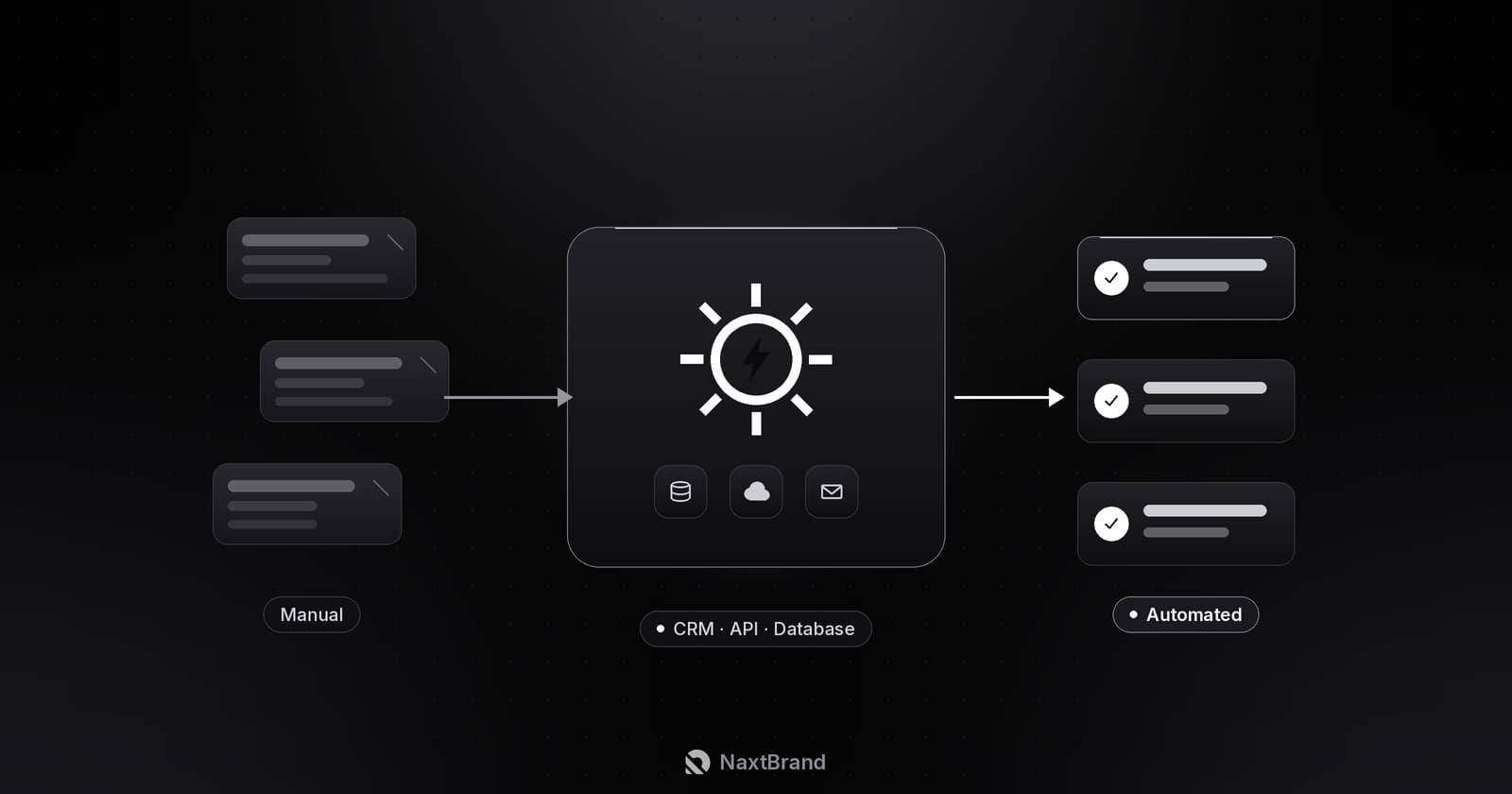
The Silent Cost of Manual Business Workflows
As businesses scale, operational complexity compounds quickly. Team members find themselves manually copying lead details from web forms into spreadsheets, retyping invoice data into accounting software, and sending repetitive follow-up emails across WhatsApp and Slack.
These fragmented, manual handovers create hidden friction:
- Delayed Response Times: Leads waiting hours for an initial outreach have a 60% lower close rate than those contacted within five minutes.
- Data Inconsistencies: Manual copy-pasting inevitably leads to typos, misplaced customer records, and lost sales opportunities.
- Employee Burnout: Talented specialists spend hours on robotic data entry rather than creative problem-solving and client strategy.
At NaxtBrand, our automation engineers build unified, intelligent bridges across your digital tools to keep your business operating 24/7 without friction.
"Automation is not about replacing human talent. It is about liberating your team from robotic tasks so they can focus on high-value human relationships."
How Intelligent Workflow Automation Works
Unlike basic zap-based automations of the past, modern AI workflow automation combines API connectivity, event-driven webhooks, and intelligent decision logic:
- Event Triggers: An action occurs—such as a prospective client submitting a project inquiry through your NaxtBrand contact form.
- Context Enrichment & AI Parsing: An AI model evaluates the inquiry text, classifies the project scope, extracts budget parameters, and checks internal calendar availability.
- Multi-System Orchestration: The workflow instantly updates your CRM (HubSpot, Salesforce, or Notion), sends an internal notification to Slack, and drafts a personalized email response for review.
- Automated Follow-ups: If no response is received after 48 hours, a gentle reminder sequence activates automatically.
Our automation engineer Farhan Mahmud and the solutions team design custom workflows using modern integration frameworks such as n8n, Make, and direct REST APIs.
High-Impact Workflows Every Growing Brand Needs
Here are three real-world automations delivering immediate returns for our clients:
1. Instant Lead Triage & WhatsApp Notification
When a prospect requests a consultation, the lead is verified, enriched with company data via Clearbit or LinkedIn, and routed directly to the appropriate account executive on WhatsApp with a single-click call button.
2. Client Onboarding & Contract Generation
Upon winning a deal, an automated workflow generates custom service agreements, provisions shared workspace directories in Google Drive, and invites team members to Slack channels within 60 seconds.
3. Real-Time Marketing Attribution & Reporting
Ad spend and conversion data from Google Ads and Meta are combined with CRM pipeline updates, generating an executive dashboard that updates automatically every morning.
Learn how we capture high-intent traffic to feed these automated pipelines in our guide on Paid Advertising & Funnel Optimization.
Transitioning from Workflows to Autonomous AI Agents
While traditional workflow automations follow strict if-this-then-that recipes, the next frontier is autonomous AI agents capable of reasoning, planning multi-step actions, and coordinating complex tasks autonomously.
To discover how AI agents are transforming enterprise operations, read our sister guide: What Are AI Agents and How Are Growing Businesses Using Them Today?.
Scale Your Operations with NaxtBrand
Workflow automation is only as strong as the digital foundation beneath it. That’s why NaxtBrand pairs automation solutions with custom web engineering and UX design:
- Discover how clean code underpins seamless API integrations in Why Modern Web Engineering Matters for Scaling Brands.
- Learn about our team credentials and delivery process on the About NaxtBrand page.
Ready to audit your operations and build custom automated workflows? Schedule an automation consultation with NaxtBrand today.
Deep-Dive: Architectural Architecture for Multi-Step AI Automation
When engineering enterprise AI automations, organizations must transition from fragile single-prompt scripts to deterministic, observable state machines. In production environments, three architectural layers determine resilience:
- Ingestion & Normalization Layer: Webhooks, email parsers, and API polling mechanisms that clean raw inbound payloads, validate schemas using type definitions, and enqueue events into persistent message brokers (e.g., Redis Streams or AWS SQS).
- Context Retrieval & Semantic Reasoning: Vector embeddings generated via text-embedding-3-small and indexed in pgvector or Pinecone. Contextual chunks are retrieved using hybrid search (combining BM25 keyword matching with dense vector cosine similarity) and passed through cross-encoder re-ranking.
- Deterministic Tool Execution & Feedback Loop: Rather than allowing LLMs to directly execute destructive database mutations, actions are routed through strict API boundary guards with human-in-the-loop approval thresholds for high-stakes actions.
Technical Implementation Checklist for Enterprise Teams
- Deploy workflow engines in isolated Docker containers with automated health checks.
- Configure rate limiters and exponential backoff retry logic on all external LLM API requests.
- Implement cryptographic HMAC verification on all incoming webhook payloads from CRMs and payment gateways.
- Establish strict semantic audit logging to track token consumption, latency, and prompt drift over time.