What Are AI Agents and How Are Growing Businesses Using Them Today?
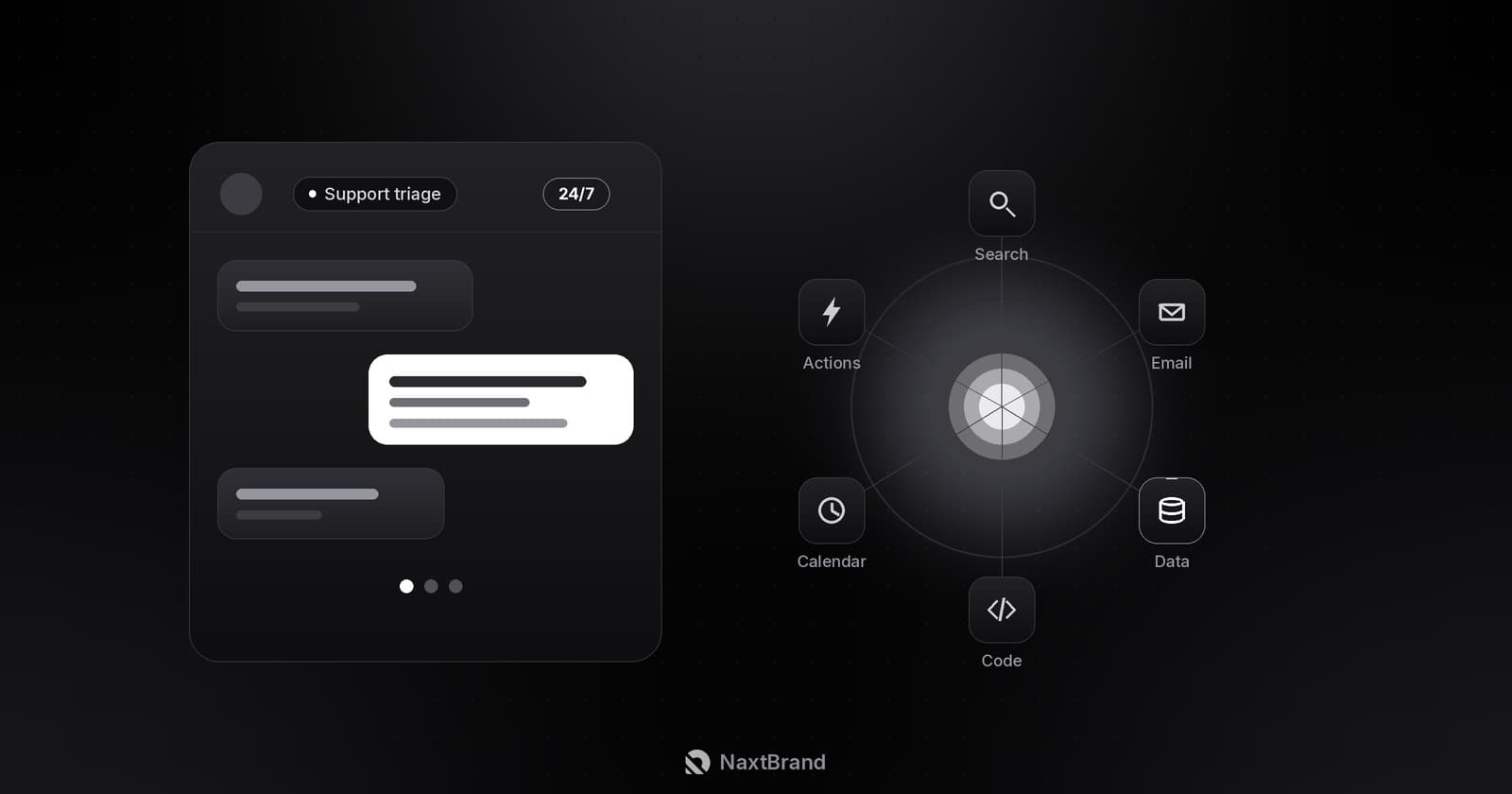
Beyond Chatbots: The Dawn of Autonomous AI Agents
For years, the word "chatbot" conjured images of frustrating pop-ups with rigid pre-written options that failed to answer basic customer inquiries.
Today, the landscape has radically shifted. We have entered the era of autonomous AI agents—software systems powered by Large Language Models (LLMs) that can reason, plan multi-step workflows, query private databases, and take real-world actions autonomously.
At NaxtBrand, our full-stack engineering team builds custom AI agents that act as tireless force multipliers for growing businesses.
"A traditional chatbot speaks from a script. An AI agent understands your business goals, references your proprietary knowledge base, and executes tasks on your behalf."
How AI Agents Differ from Traditional Automation
To understand the breakthrough of AI agents, consider how they compare to standard rule-based automations:
- Rule-Based Automation: Strictly follows deterministic rules. If a customer writes an unexpected response or submits unstructured data, the workflow halts with an error.
- AI Agents: Utilize semantic understanding and tool calling. If an input is messy or incomplete, an agent asks clarifying questions, parses natural language intent, and determines which API tool to execute next.
Our full-stack engineer Nusrat Jahan and the engineering team integrate AI agents directly into web applications, CRMs, and backend databases.
Key Business Applications in Production Today
How are ambitious companies utilizing AI agents right now to achieve operational leverage?
1. 24/7 Intelligent Client Triage & Lead Qualification
Instead of forcing potential clients to fill out static multi-page forms, an AI concierge engages visitors in natural conversation. It understands their project scope, checks company service boundaries, and books appointments on your calendar without human delay.
2. Internal Enterprise Knowledge Retrieval (RAG)
When team members need to reference company SOPs, previous proposals, or technical documentation, an internal AI agent retrieves exact citations within seconds using Retrieval-Augmented Generation (RAG) and vector databases.
3. Automated Code Review & Content Validation
In software and digital publishing environments, AI agents perform automated checks on code quality, schema validation, and accessibility before changes reach production environments.
Learn how we build rock-solid architectures that support agentic integrations in Why Modern Web Engineering Matters for Scaling Brands.
Safety, Governance, and Human-in-the-Loop Architecture
Deploying AI agents safely requires rigorous engineering standards. At NaxtBrand, we implement:
- Strict Access Control: Agents only query authorized internal data and cannot access sensitive payment or private credentials.
- Hallucination Guardrails: Prompts are grounded in verified documentation with deterministic fallback paths.
- Human-in-the-Loop (HITL) Checkpoints: High-stakes decisions—such as issuing financial refunds or publishing external client agreements—require explicit team approval before execution.
Review how we orchestrate seamless API workflows in our guide on AI Workflow Automation: Connecting Systems for Efficiency.
The NaxtBrand Approach to AI Engineering
We believe AI should solve practical commercial problems, not serve as experimental theater. Every agent we deploy is built on clean APIs, measurable ROI milestones, and scalable web infrastructure.
- Meet our leadership and engineering team on the About NaxtBrand page.
- Discover how intuitive design makes complex AI agents easy to use in The ROI of High-Craft UI/UX Design.
Want to explore how custom AI agents can automate repetitive workloads in your business? Consult with the NaxtBrand engineering team to discuss a proof of concept.
Technical Anatomy of Autonomous AI Agents: Planning, Memory, and Tools
Unlike traditional chatbots that simply generate conversational text, autonomous AI agents operate through an integrated loop of perception, planning, tool invocation, and reflection:
- The Reasoning Core (LLM): Directs situational awareness and breaks complex high-level goals into sequential task graphs.
- Episodic & Semantic Memory:
- Short-Term Memory: In-context conversation state and recent tool execution logs.
- Long-Term Memory: Vector database lookups retrieving historical client records, past resolutions, and domain knowledge.
- Tool Use & API Execution: Agents invoke external APIs via strictly typed schemas (JSON schema / function calling) to inspect databases, send transactional emails, issue invoices, or manipulate codebases.
- Self-Correction & Reflection: After receiving an API response, the agent validates whether the outcome matches expected criteria and automatically retries with modified parameters if an error occurs.
Engineering Guidelines for Safe Agent Deployment
- Establish strict sandboxing and role-based access control (RBAC) on all tool execution APIs.
- Implement rate limiters and maximum iteration bounds to prevent runaway recursive execution loops.
- Require cryptographic human approval tokens before executing destructive financial or database updates.
- Maintain comprehensive telemetry tracing all agent thoughts, tool arguments, and execution outputs.