Technical SEO & Core Web Vitals: How Modern Architecture Ranks You Higher
Beyond Keyword Stuffing: The Era of Technical Search Authority
Search Engine Optimization (SEO) has fundamentally transformed over the past few years. Gone are the days when repeating target keywords in metadata and buying low-quality backlinks could propel a website to page one of Google.
Today, search engines deploy sophisticated machine-learning models that evaluate user satisfaction, technical stability, and genuine content authority.
At NaxtBrand, we approach SEO not as an isolated marketing tactic, but as an integral part of your platform’s software engineering and information architecture.
"If Google's crawlers struggle to parse your JavaScript or your users bounce due to sluggish responsiveness, even the most brilliant copywriting will remain invisible."
Mastering Google's Core Web Vitals
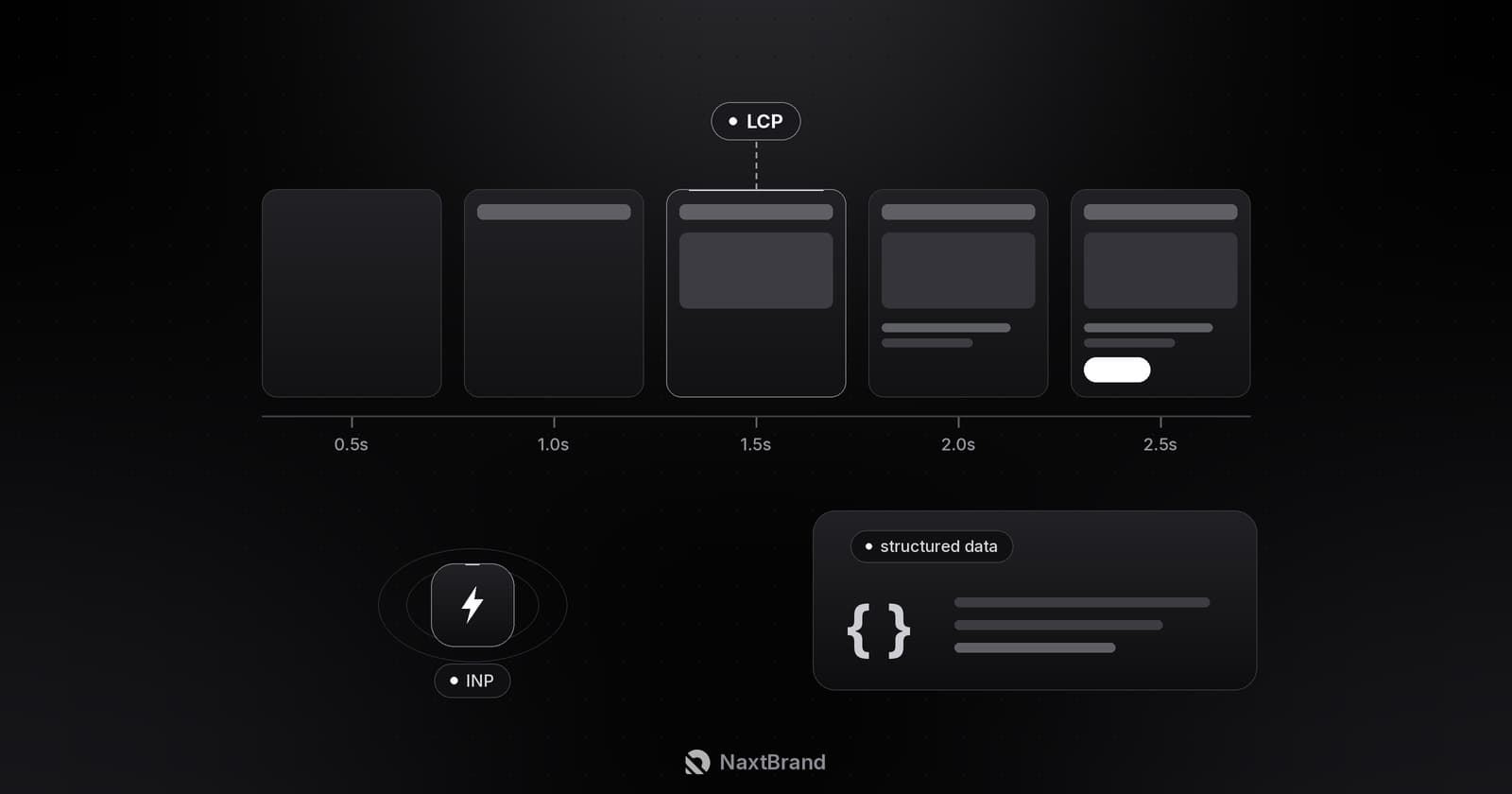
Google’s Core Web Vitals measure the real-world experience of visitors interacting with your site. Optimizing these metrics is critical for both ranking and conversion retention:
1. Largest Contentful Paint (LCP)
LCP measures perceived load speed by tracking how quickly the main visual block (hero banner, title, or main image) renders on screen. A good score is under 2.5 seconds.
- We achieve this through server-side caching, edge delivery networks, and prioritizing high-impact images using Next.js image optimization.
2. Interaction to Next Paint (INP)
Replacing First Input Delay (FID), INP evaluates your site's overall responsiveness to clicks, taps, and keypresses throughout the entire session. A good INP score is under 200 milliseconds.
- Sluggish third-party scripts and bloated tracking pixels are the leading culprits behind poor INP scores. We audit and streamline client-side execution to keep the main thread unblocked.
3. Cumulative Layout Shift (CLS)
CLS measures visual stability. If buttons or paragraphs shift downward as ads or slow-loading fonts pop in, users accidentally click the wrong element. A good CLS score is under 0.1.
- We specify explicit aspect ratios for all media and utilize preloaded local fonts to guarantee visual lock-in from the first frame.
Learn how our engineering foundation eliminates performance bottlenecks in Why Modern Web Engineering Matters for Scaling Brands.
Essential Technical Architecture Checklist
Achieving organic search dominance requires consistent technical hygiene:
- Semantic HTML5 Hierarchy: Utilizing a single
<h1>per page, followed by logical<h2>and<h3>tags, ensures search engines understand your content structure. - JSON-LD Structured Data: Providing rich Schema.org markup (Organization, WebSite, FAQPage, Article, and LocalBusiness) helps search engines display rich snippets in SERP results.
- Clean Canonical and Indexation Strategy: Eliminating duplicate query-string URLs with proper canonical tags and maintaining an automatically updated XML sitemap.
- Internal Linking Topology: Strategically linking high-authority hub pages to related topical articles to distribute link equity throughout your domain.
Our growth strategist Ayaan Rahman and the NaxtBrand team specialize in designing end-to-end organic acquisition strategies tailored to high-growth sectors.
Synergy Between SEO and Paid Advertising
The highest-performing digital brands do not rely on organic search alone. They leverage SEO in tandem with targeted pay-per-click advertising:
- High-quality search intent data reveals which terms deliver the highest conversion rates, informing profitable paid ad campaigns.
- Fast, optimized landing pages improve Google Ads Quality Scores, significantly lowering your Cost-Per-Click (CPC).
Learn how to scale your acquisition pipeline in our article on Paid Advertising & Funnel Optimization: Maximizing ROAS.
Partner with NaxtBrand for Measurable Growth
At NaxtBrand, we reject one-size-fits-all SEO checklists. We conduct deep-dive technical audits, resolve server-side bottlenecks, create authoritative content architectures, and deliver transparent reporting so you can track your business impact every month.
- Explore our multidisciplinary approach and core values on our About NaxtBrand page.
- Review how we convert inbound search traffic into qualified leads in AI Workflow Automation for Modern Businesses.
Ready to claim high-intent search market share? Request a comprehensive SEO & performance audit from NaxtBrand today.
Advanced Technical Optimization: LCP, INP, and CLS Remediation
Mastering Google's Core Web Vitals requires treating performance as an ongoing engineering discipline rather than a one-time audit:
1. Largest Contentful Paint (LCP) Optimization
- Preload Critical Assets: Inject
<link rel="preload" as="image" href="..." fetchpriority="high">in the document head for above-the-fold hero imagery. - Server-Side Rendering (SSR): Ensure critical DOM nodes render directly into initial HTML so search bots do not wait for client hydration.
- Modern Next-Gen Image Compression: Convert all visual assets to AVIF and WebP formats, maintaining sub-100KB file sizes without perceptual loss.
2. Interaction to Next Paint (INP) Remediation
- Main-Thread Task Splitting: Break long JavaScript tasks (> 50ms) using
scheduler.yield()orrequestIdleCallback()to maintain UI responsiveness during background processing. - Defer Non-Critical Scripts: Move analytics trackers and chat widgets into Web Workers or execute them only after user interaction.
- Eliminate Heavy DOM Trees: Keep total DOM node counts below 800 elements to minimize layout recalibration costs.
3. Cumulative Layout Shift (CLS) Stabilization
- Explicit Dimension Sizing: Always declare
widthandheightattributes or CSSaspect-ratioon images, video containers, and ad frames. - Font Display Optional: Use
font-display: swapwith font metric overrides (ascent-override,descent-override) to eliminate flash of unstyled text (FOUT) shifts.